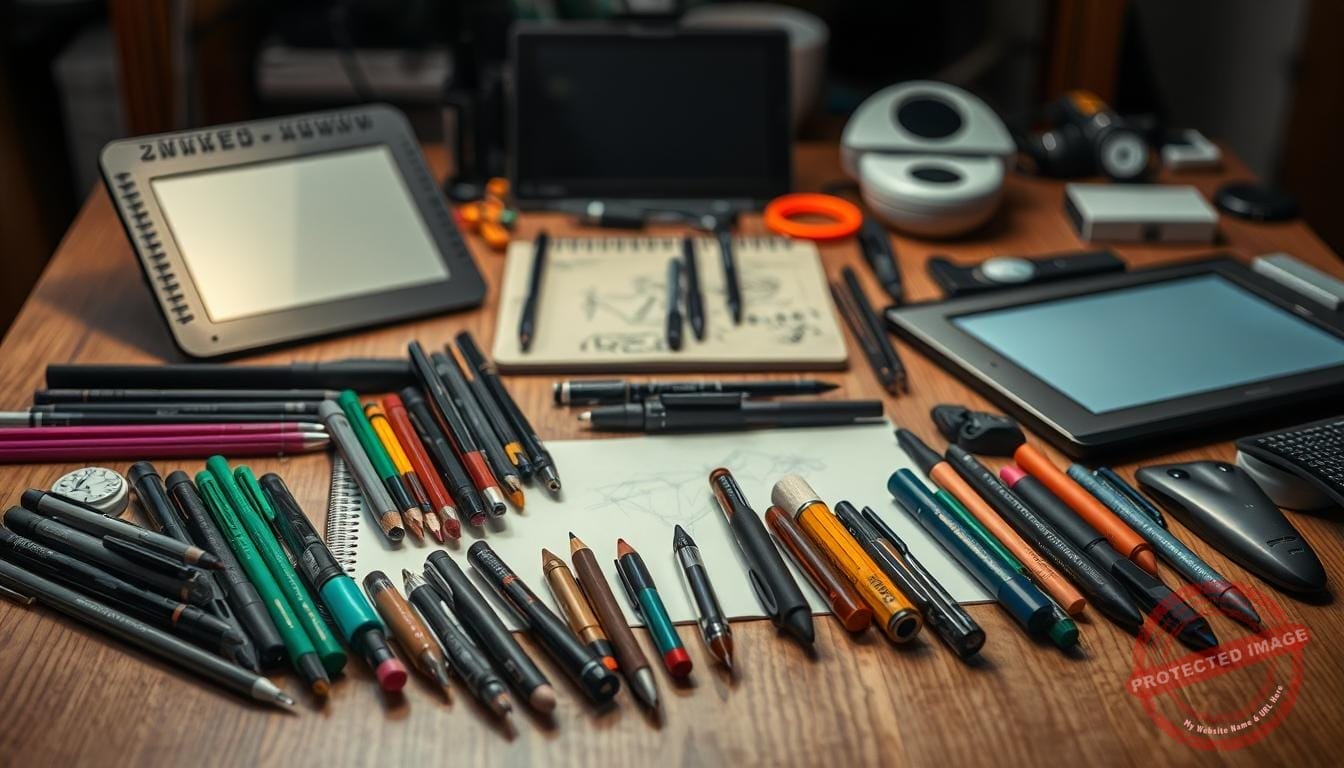
I start with a fact that often surprises visitors: over 70% of artists say a single reliable instrument changed how they make art in the studio and on large formats.
I curate a living showcase where each pick, from Jerry’s Jumbo Jet Charcoal Pencil to Cezanne Graphite Drawing Pencils, earns its place by delivering predictable feel and rich marks. I test items like Acurit Waterproof Technical Pens for lightfast ink and Acurit PXB Drawing Boards for precise parallel lines.
I focus on the features that matter: consistency on the page, break‑resistant tips for large studies, and a wide tonal range for gallery-ready artwork. My goal is practical—helping artists choose the right materials and the best option for each phase of a piece.
Visit my Mystic Palette Art Gallery to feel the supplies, try papers, and ask about custom requests or starter sets. For inquiries, please contact me.
Key Takeaways
- I showcase reliable picks that lift studio work and finished pieces.
- Each selection highlights practical features like colorfast ink, stable boards, and tonal variety.
- Products range from bold charcoal pencils to precise technical pens.
- Materials are chosen to speed workflow, not complicate it.
- Try them in person at Mystic Palette Art Gallery or contact me for custom sets.
Why I Curate Innovative Drawing Tools for Today’s Artists
My approach is hands-on: I use each item the way a working artist would, from quick studies to final passes. I test for speed, repeatability, and how the materials respond across different media.
How I test tools across graphite, ink, and mixed media
I evaluate Cezanne graphite across the full 6H–12B range for smooth application and subtle values. I compare Acurit Waterproof Technical Pens across 0.1–1.0 mm nibs for consistent, lightfast, acid‑free ink. I also test Jumbo Jet Charcoal for jet‑black coverage and break‑resistant tips on large formats.
Balancing precision, texture, and speed for real studio workflows
I time workflows from thumbnails to final lines. I check nib mapping to subject areas and paper tooth for cross‑hatching or blending. I stress-test durability through sharpening and repeated use to confirm an artist can rely on the same result over time.
| Item | Focus | Key Result |
|---|---|---|
| Cezanne Graphite | Value range (6H–12B) | Smooth transitions, wide tonal range |
| Acurit Pens | Nibs 0.1–1.0 mm | Lightfast, crisp detail |
| Jumbo Jet Charcoal | Large format coverage | Deep blacks, durable tips |
| Acurit PXB Board | Drafting repeatability | Accurate parallel motion, stable dials |

Visit our Mystic Palette Art Gallery to see samples and ask for custom recommendations. For custom requests or inquiries, please contact us.
Innovative Drawing Tools
I pick each item because it solves a specific problem I face in the studio. These selections help me move from quick sketches to finished drawings with fewer interruptions and truer results.

Graphite reimagined: Cezanne ranges for nuanced value and control
The Cezanne graphite pencils span 16 degrees from 6H to 12B. I use harder grades for structure and softer grades for deep, velvety shadows.
Bold charcoal power: Jumbo Jet pencils for jet‑black lines and large formats
Jerry’s Jumbo Jet charcoal pencil has an oil‑impregnated core nearly 50% larger than a typical pencil. It lays down darker‑than‑graphite marks and resists breakage during fast work.
Waterproof precision: Acurit technical pens with rich, lightfast ink
Acurit pens ship in nibs from 0.1 to 1.0 mm. I pick sizes by the line weight I need—fine contours or bold outlines—knowing the pigment ink stays put and won’t smudge under watercolor washes.
Stable work surfaces: Acurit PXB parallel boards for accurate drafting
The PXB board keeps large sheets flat and produces true parallel lines. I lock horizons and grids quickly and avoid redoing perspective work.
Smart erasing and blending: kneaded erasers, vinyl erasers, and stumps
I pair a kneaded eraser with vinyl and gum erasers to lift marks without harming the paper. Blending stumps preserve tooth and build smooth transitions that keep textures clear.
- Plan: light H pencils for layout, B pencils to commit, then the Jumbo Jet to anchor darks.
- Switch: pencil for form, pen for crisp, permanent lines.
- Stabilize: use the PXB board to prevent sheet creep on long sessions.

For custom requests or inquiries, please contact us. Learn more about new technical pens in my recommended kit: new technical pens.
New materials that transform light, texture, and mood
New surface materials can change how a piece catches light and how viewers feel its depth. I use select additives to expand my range and to create moments that read differently under gallery lights and at night.
Metallic inks and luminous paints for reflective, glowing highlights
I apply metallic inks along contours to catch ambient light. Reflective particles shimmer as viewers move, adding subtle emphasis without altering form.
I also layer luminous paints for soft radiance. These paints absorb light and emit a gentle glow that guides the eye in low light.
Glow-in-the-dark accents for night-view effects
Glow materials let a single artwork offer two experiences: daytime detail and a nighttime reveal. I test intensity and placement on swatches first.
Textural additives: modeling paste and gel medium
Modeling paste builds raised relief that holds graphite and ink. I imprint fabric or tools into the paste for tactile textures.
Gel medium unifies mixed layers, creating a translucent body that keeps marks crisp while preserving paper tooth underneath.
- I blend drawing media with these materials to widen my options and to enrich mixed media work.
- I keep separate brushes for metallic and glow products to avoid contamination.
- Samples are on display at Mystic Palette Art Gallery—visit to see and feel the range in person.
| Material | Effect | Best Use |
|---|---|---|
| Metallic inks | Reflective highlights | Edges, contours, tiny accents |
| Luminous paints | Soft glow | Subtle passages, halos |
| Glow-in-the-dark | Night-view reveal | Alternate lighting displays |
| Modeling paste | Raised texture | Dimensional collage, impasto-like relief |
| Gel medium | Translucent binder | Layer unification, collage adhesion |
Visit our Mystic Palette Art Gallery. For custom requests or inquiries, please contact us.
Traditional meets technical: pens, papers, and inks I rely on

Blending classic materials with technical drafting habits keeps my work both expressive and reproducible.
I use New York Central India Ink when I need archival, waterproof, lightfast marks that scan cleanly. The velvet matte finish works well with Acurit Waterproof Technical Pens in 0.1–1.0 mm sizes for precise line work.
For expressive line variation I switch to a dip pen. The ink stays permanent and the pen gives subtle flex, so my lines remain lively and durable on final surfaces.
Tracing and transfers
SoHo Urban Artist Tracing Paper Pads let me test layouts without committing to a final sheet. I overlay studies, refine with pencil, then transfer the best version to Strathmore or Bristol.
Bristol gives ultra-smooth response for inks. Charcoal paper adds texture when I want character. I pay attention to tooth, weight, and acid-free quality, just as The Virtual Instructor recommends.
- I sketch with graphite pencils, then lock edges with pen so final lines feel intentional.
- I refine lines using kneaded, vinyl, and gum erasers to protect the surface.
- I favor consistent line weights for clear, reproduction-ready technical drawing.
For custom requests or inquiries, please contact us. Learn about my preferred drawing pens to match pen, ink, and paper for repeatable results.
Digital tools and hybrid workflows I recommend
I use screens not to replace paper but to expand what my hands can do with line and tone.
Tablets and styluses that feel like a pencil
I sketch on Wacom Cintiq 16 and Huion Kamvas 13 when I need tethered studio precision. Both offer high‑resolution displays, tilt recognition, and battery‑free styluses that respond like a familiar pen.
For travel and instant iteration I reach for an iPad Pro with Apple Pencil. The screen and latency make it easy to move between quick studies and finished work.
Software, brushes, layers, and color management
Adobe Photoshop and Illustrator give me layers, masking, and brush engines that simulate my favorite pencils and pens. I tune settings until the brushes echo real materials, then save presets to speed mixed media passages.
Color profiles and soft proofing keep my prints true. Calibrating monitors means the way tones read on screen matches the final surface more reliably.
Scanning, compositing, and keeping paper texture
I scan paper studies at high resolution to preserve tooth and surface character. Once digital, I composite, adjust contrast, and add subtle texture layers so the analog marks remain visible.
Then I print light guides to refine with pen or pencil on final paper, plotting a practical way to translate pixels back into physical art.
- I build compositions in layers so edits stay non‑destructive.
- I test stylus latency and pressure curves to confirm my ability to hatch and feather.
- I blend analog and digital methods to widen my range across mixed media work.
“Hybrid workflows let the hand lead while the screen expands what is possible.”
Visit our Mystic Palette Art Gallery. For custom requests or inquiries, please contact us.
Eco‑friendly options without compromising performance
I choose materials that honor the planet without asking me to sacrifice how my work performs.
Start small and practical: the right paper and inks can cut waste while keeping workflow steady. I look for recycled paper stocks with honest tooth so my pencils track cleanly and erasing does not pill the surface.
Recycled papers and natural pigments for sustainable sketching
I test natural pigment inks and washes for saturation, drying time, and archival stability. These options meet daily studio demands and behave like premium drawing materials.
Biodegradable materials that respect your studio and the planet
I pick biodegradable supplies that store well and avoid off‑gassing in sensitive areas. I check that pencils and erasers hold a point and lift cleanly so fine details are preserved.
| Item | Eco Feature | Performance | Best Use |
|---|---|---|---|
| Recycled paper | Post‑consumer fiber | Reliable tooth, low pilling | Sketches, studies, mixed media |
| Natural pigment ink | Plant/mineral dyes | Good saturation, archival | Inks, washes, line work |
| Biodegradable pencil | Compostable casing | Stable core, precise point | Detail work, on‑the‑go sketches |
| Minimal packaging kit | Recycled wrapping | Same opacity and blendability | Studio starter option |
- Options span budgets—start with paper, then add pigments and binders.
- I compare art supplies side by side so artists use choices that match opacity and edge definition.
- Visit our Mystic Palette Art Gallery to sample eco lines and ask about sustainable materials tools.
Visit our Mystic Palette Art Gallery. For custom requests or inquiries, please contact us.
Conclusion
I wrap up with the essential kit that keeps my studio work steady and reliable.
I trust Cezanne graphite across a wide range, Acurit Waterproof Technical pens (0.1–1.0 mm) for consistent pigment ink, and Jerry’s Jumbo Jet charcoal for deep values on large surfaces.
Bristol and charcoal paper, plus an Acurit PXB parallel board, give the stable surface I need for both expressive sketches and precise technical work.
Keep a sharp pencil for structure, a softer one for shading, and a dependable pen for edges. Erasers and stumps refine techniques so your drawings stay clean and repeatable.
Visit our Mystic Palette Art Gallery. For custom requests or inquiries, please contact us.
FAQ
How do I choose between graphite, charcoal, and ink for a project?
I pick media by the mood and scale I want. For subtle value shifts and fine detail I reach for graphite pencils like the Cezanne ranges. For big, expressive marks and deep blacks I choose jumbo charcoal pencils. When I need crisp, archival lines that scan well, India ink with technical pens or dip nibs is my go‑to. I also test papers and surfaces first so the media and support work together.
What papers work best with mixed media and heavy texture?
I prefer heavyweight, cold‑pressed watercolor or mixed‑media pads for layering modeling paste, gel medium, and metallic inks. Those papers can take abrasion and moisture without buckling. For precise ink work I use smooth, artist‑grade bristol or hot‑pressed rag paper to avoid feathering. I always test a small swatch to confirm how the surface accepts washes and additives.
Which erasers and blending tools should I keep in my studio?
I keep a kneaded eraser for lifting subtle highlights, a vinyl eraser for clean edge removal, and a selection of stumps for soft blending. Each tool gives different control: kneaded for gentle tweaks, vinyl for stubborn marks, and stumps for smooth gradations. They’re small investments that change how I shape light and form.
Can I combine traditional media with digital workflows?
Absolutely. I often start on paper, then scan high‑resolution images to refine in software. Tablets like Wacom, Huion, or an iPad Pro with a pressure‑sensitive stylus let me retain the tactile feel while using layers, custom brushes, and color corrections. Scanning textured paper and compositing those layers keeps the analog character alive.
How do I ensure my ink and pigments remain lightfast and archival?
I select lightfast, pigment‑based inks and paints from reputable brands and avoid dye‑based alternatives for finished pieces. Technical pens with archival, waterproof ink and artist‑grade India ink are reliable. I also store and display work away from direct sunlight and use UV‑protective framing when possible.
What are some effective ways to add luminous or metallic highlights?
I use metallic inks and luminous paints in thin layers to create reflective accents without obscuring underlying details. For subtle glow effects I combine glow‑in‑the‑dark pigments with matte mediums so the surface keeps depth under gallery lighting. Light application and testing help me avoid overpowering the composition.
Which drafting surfaces help with precision and parallel alignment?
I rely on stable board systems and parallel drafting boards that lock edges and keep rulers true. A solid work surface prevents skews when I use technical pens or do measured layouts. For reproducible technical drawings I pair the board with a calibrated straightedge and quality mechanical pencils.
Are there sustainable art supplies that still perform well?
Yes. I choose recycled papers and natural‑pigment paints when possible, and I look for biodegradable packaging and refillable pens. Many brands now offer durable, eco‑friendly options that don’t sacrifice pigment quality or archival standards. Testing for longevity and lightfastness remains part of my selection process.
How can beginners build a versatile starter kit without overspending?
I advise picking a handful of reliable, multiuse items: a mid‑range graphite set, a charcoal pencil or stick, a small bottle of India ink with a technical pen, a kneaded eraser, blending stumps, and a mixed‑media pad. Add one metallic or luminous accent and a basic tablet or scanner if you plan to digitize work. Buy one quality brand item first and supplement with budget picks to learn what matters to you.
What maintenance do pens, brushes, and boards need to last?
I clean brushes and pen nibs immediately after use to prevent clogging and corrosion. For technical pens I flush with appropriate cleaner and store them upright. I wipe boards and parallel edges with a soft cloth and keep paper clips and weights rust‑free. Regular care extends the life of materials and keeps results consistent.


