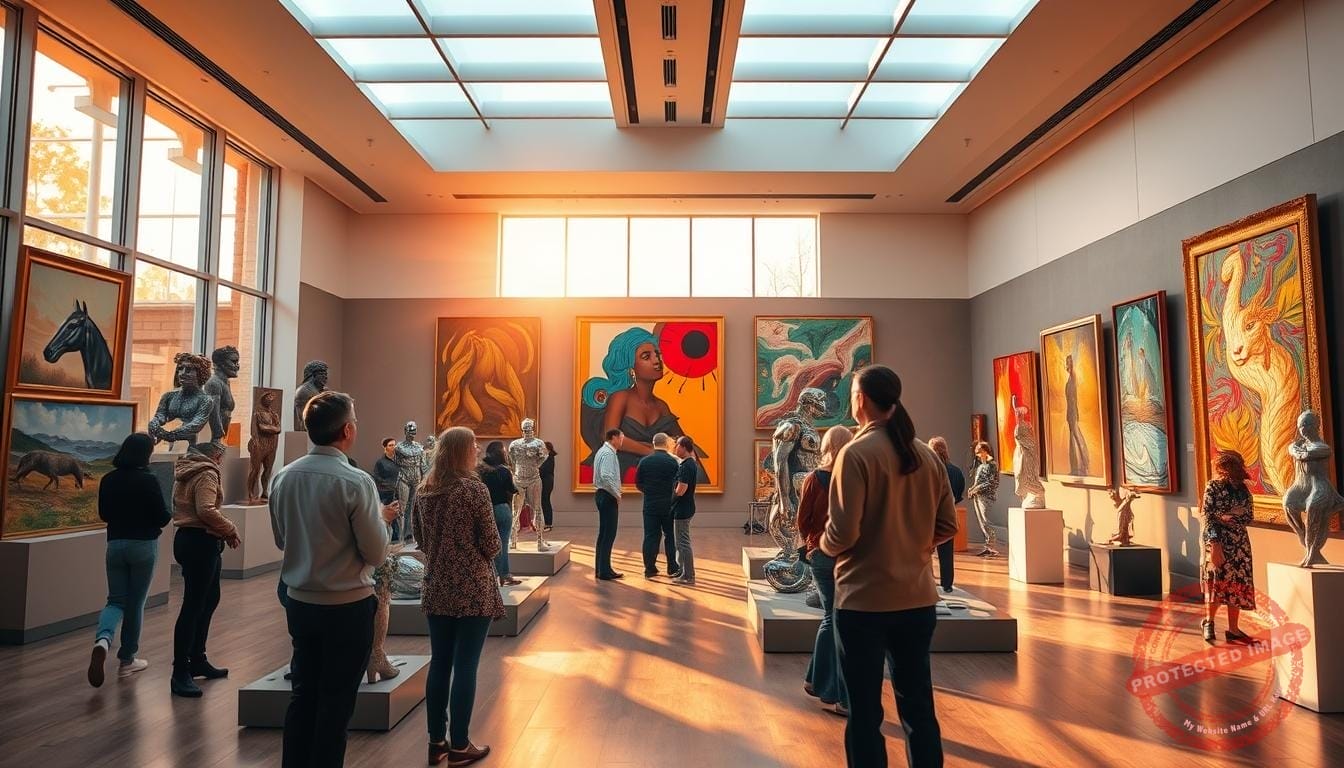
Did you know a single gallery installation can display thousands of evolving images in one night? I invite you to step into Mystic Palette, where I blend art with artificial intelligence to shape expressive images and live installations.
In my studio, algorithms learn from data and models respond to prompts I craft. I use those outputs as raw content and refine them into gallery-ready pieces that keep a human story at their heart.
At the gallery you’ll find live demos, evolving digital art displays, and behind-the-scenes glimpses into my creative process. I show how I choose tools, iterate with intention, and curate each image so it reads clearly on wall and screen.
Come for workshops, stay for demos, and leave with new ideas about how artists and audiences can explore emerging trends together. Visit Mystic Palette today, and if you want a custom piece, please contact me to discuss your vision and next steps.
Key Takeaways
- I invite you to experience live, evolving displays at Mystic Palette.
- I combine artificial intelligence models with a hands-on creative process.
- You’ll see how I pick tools, craft prompts, and curate final images.
- Workshops and demos make complex techniques accessible to visitors.
- Rapid advances are opening fresh trends and community moments now.
- Contact me for custom commissions or to arrange a studio visit.
What I Mean by AI Art Processing and Why It Matters Today
I guide computational systems to explore style and composition, then shape those discoveries into gallery work.
I define this pathway as the move from inputs and algorithms to a finished piece. Models learn patterns from curated data and then propose new images. My job is to read, select, and refine those proposals so each piece feels intentional.
From algorithms to artwork: how models turn data into images

Generative setups—GANs, VAEs, and diffusion—train on datasets to learn style and texture. A model maps patterns in data and then generates novel images that echo what it learned without copying.
Why this matters now: faster systems and better training make image creation accessible. Natural language prompts let me steer focus. Machines bring scale and variety; my eye brings meaning, composition, and cohesion across artworks.
- I care about responsible data choices because diversity affects fairness and originality.
- You’ll see these steps in my live demos at Mystic Palette, where I narrate each stage.
Setting Up: My Essential Tools and Accounts
My studio setup starts with a shortlist of platforms that match the visual goals for a project. I choose platforms that give me the look, control, and delivery path I need.
Platforms I rely on:
- Midjourney for painterly aesthetics.
- DALL·E for precise edits and inpainting.
- Stable Diffusion (DreamStudio / Automatic1111) for local control and experimentation.
- Runway Gen series for quick video drafts and post work.
- Flux for realistic outputs and polished images.
I set up accounts in this order: a hosted generator for fast tests, a paid plan with GPU access if needed, then a local install for deeper experiments. Subscription tiers, GPU needs, and web vs. local workflows shape that choice.
How I stay organized: I version prompts, save seeds, and keep project files in dated folders. This makes it easy to reproduce results and hand assets to clients.
Visit Mystic Palette Art Gallery to see these systems side by side in live demos. You’ll watch me test models, explain techniques, and demo my day-to-day skills.
ai art processing: A Step-by-Step Overview of My Creative Flow

My workflow turns a loose concept into cohesive images and motion pieces, step by step.
Plan, prompt, iterate, refine, and finalize
I begin by planning intent, mood, and the final display context. Then I craft prompts or select a strong input image to steer the work.
I generate first images with text-to-image when exploring ideas. I switch to image-to-image to preserve composition while changing styles. For motion or ambient loops I move into text-to-video tests.
Parameters matter: guidance scale for fidelity, seed for reproducibility, and sampler for grain and detail. I log models, data sources, and choices so every step is repeatable.
When I switch between text-to-image, image-to-image, and text-to-video
I iterate rapidly, adjust wording or inputs, then refine with post-processing to polish color, scale, and texture. I enforce style coherence across a series so the collection reads as one family.
Visit our Mystic Palette Art Gallery to watch this end-to-end flow live, from blank prompt to finished piece.
- I document each pass so clients can see the creative process and final content.
- I apply targeted techniques in post to raise print and screen quality.
Data and Style Inputs: Curating Sources with Care
I collect a wide set of references so style direction is driven by diversity, not repetition.

Training data quality and variety determine how original and fair my outputs become. I choose sources that broaden perspective and reduce bias.
Ethical image references and style direction
I prioritize licensed archives, my own photography, and public-domain images. This helps me craft inputs that respect other artists and copyright limits.
I separate inspiration from imitation. I build clear style boards that map palette, materials, and mood so systems follow intent without copying a single artist’s signature.
How I audit inputs and document choices
- I track source provenance and note any attribution needed.
- I mix eras, regions, and media to keep the collection inclusive.
- I test outputs for repetition and adjust references when bias appears.
| Source | License | Typical Use | Impact on Bias |
|---|---|---|---|
| My photography | Owned | Primary references, texture, light | Low — high control |
| Licensed archives | Commercial | Style cues, composition | Medium — curated diversity |
| Public-domain | Public | Historical styles, motifs | Low — check representation |
| Contemporary artists (with permission) | Licensed/Agreed | Collaborative direction | Low — transparent attribution |
“Ethical curation makes the final content stronger and fairer.”
Visit our Mystic Palette Art Gallery to review these curated inputs during open studio hours and see how data and style shape the finished pieces.
Prompts That Paint: How I Write and Evolve Effective Inputs
I shape prompts so they act like a painter’s sketch—clear, suggestive, and tuned for iteration.
Positive prompts anchor the subject, environment, lighting, and medium so the final image reads cleanly. I add concise cues for lens, palette, or brushwork to guide the model toward the mood I want.
Negative prompts remove distractions and artifacts. They keep unwanted elements out of images and help preserve clean composition during repeats.
Positive vs. negative prompts and guidance scale
I set guidance scale to balance fidelity to text versus creative exploration. Lower values invite surprise; higher values keep results faithful to the prompt.
Seeds, samplers, and controlling randomness
A fixed seed makes outputs repeatable for client approvals. Changing seeds quickly expands options when I need variety.
- I structure prompts with subject, environment, lighting, lens or medium cues, and style constraints that translate into strong images.
- I tune guidance scale to match the goal: tighter for precise commissions, looser for experimental series.
- I pick samplers that favor painterly texture or crisp detail depending on the piece.
- I edit prompts across versions to evolve the idea while keeping composition consistent.
- I organize prompt variants in dated folders so clients can track choices and give targeted feedback.
“For custom concepts or prompt help, please contact us.”
Under the Hood: GANs, VAEs, and Diffusion in Plain English
Let me show you how different neural systems translate source patterns into visual possibilities.
Generative adversarial networks and the generator-discriminator dance
Generative adversarial setups pair two networks: one creates candidates and the other checks them. The generator learns to imitate data while the discriminator learns to spot fakes.
This back-and-forth teaches the system to copy real patterns and produce convincing images. I use GANs when I want bold stylization and fast visual feedback.
VAEs and latent space exploration
Variational autoencoders compress inputs into a latent space, then decode many variations from a single idea. That makes controlled exploration easy.
I use VAEs for projects that need variety and smooth transitions across a series.
Why diffusion models dominate modern image synthesis
Diffusion models add noise then learn to remove it. Proposed around 2015, they outpaced GANs by early 2021 and now power many modern text-to-image systems.
Diffusion gives high fidelity, reliable detail, and strong prompt control. In the studio I pick the family of model that best fits composition, turnaround, and desired finish.
“See these systems side-by-side at Mystic Palette Art Gallery to watch differences come alive.”
| Model Family | Strength | Best Use |
|---|---|---|
| Generative adversarial (GAN) | Stylized results, fast iterations | Bold series, artistic texture |
| VAE | Controlled variability, smooth blends | Concept exploration, transitions |
| Diffusion | High fidelity, prompt control | Photoreal prints, detailed commissions |
Human-AI Collaboration: Where I Add Intuition, Composition, and Story
I guide machine outputs with human judgment, turning raw generations into meaningful gallery pieces.
I direct composition, color, and narrative arcs so each image serves a clear concept. I treat models as collaborators while I remain the creative lead.
I critique generated images using design fundamentals. I select, combine, and push pieces until a cohesive message emerges.
Storyboarding helps me build series that read as one exhibit. I add emotional and cultural layers—symbols, pacing, and references—so artworks convey depth machines cannot infer on their own.
- Review sessions: I refine content with clients and visitors until it resonates.
- Skills I bring: visual literacy, material studies, and worldbuilding.
- Signature finish: I merge machine results with hand-crafted passes to keep a consistent touch.
| Role | What I Control | Result |
|---|---|---|
| Human artist | Composition, narrative, cultural context | Meaningful, cohesive artworks |
| Models | Speed, variety, initial imagery | Broad options, raw content |
| Collaboration | Selection, refinement, finishing techniques | Gallery-ready pieces with signature voice |
“Join me at Mystic Palette Art Gallery to watch this collaboration unfold live, from spark to finished piece on the wall.”
From First Pass to Final Artwork: My Iteration and Polishing Process
I take a promising first image and move it through focused edits until it stands ready for the wall.
Inpainting, upscaling, and style coherence
I use inpainting to fix hands, faces, or props while keeping composition intact. Platforms like Stable Diffusion UIs let me mask and retouch specific regions quickly.
For prints I upscale carefully to avoid artifacts and keep the original style. I harmonize palette and lens cues across a set so artworks read as a single series.
Post-processing in Photoshop and Runway
My Photoshop workflow uses layered passes: contrast shaping, color grading, cleanup, and subtle paint-overs that unify the look. I save versions so clients can review each stage.
When motion helps a piece, I move sequences into Runway for gentle parallax or ambient video accents. This adds depth without changing the still image’s intent.
- I schedule targeted iterations and quality checks from first draft to framed piece.
- I tune export settings and proof prints so images reproduce reliably on screen and paper.
- I combine tools and techniques to preserve coherence across prints, prints, and video displays.

“Watch me finish and frame works at Mystic Palette, where before-and-after comparisons show the full process.”
Copyright, Licensing, and Attribution: How I Navigate the Gray Areas
I treat licensing questions as a core part of every project brief and workflow. Before I start, I review the provenance of any data or reference images I plan to use. This protects clients and honors other artists.
Training data concerns include unlicensed scraping, biased datasets, and prompts that mimic living artists’ signatures. I avoid prompts that ask for a living artist’s identifiable style. When rights are unclear, I use references only for internal mood boards and not for final deliverables.
When outputs are safe for client deliverables
Outputs are safe when they come from licensed, public-domain, or original inputs I control. I document sources and keep a manifest for every project.
My policy at a glance:
- I use licensed collections, my own photography, or public-domain sources for final images.
- I document data sources and provide a process log for transparency.
- I advise concepting with automated tools, then paint or composite toward a clear chain of title when needed.
| Risk Area | My Practice | Client Outcome |
|---|---|---|
| Unlicensed training data | Avoid use for final images; favor licensed or owned inputs | Defensible deliverables with clear provenance |
| “In the style of” prompts | No prompts that replicate living artists’ signatures | Original images that respect other artists |
| Attribution & licensing | Project agreements clarify rights, usage, and attribution | Clients get clear usage terms and peace of mind |
“Transparency and documentation turn complex rights questions into clear choices.”
If you have specific questions or a project to review, please contact us. I keep updating studio practices as policies evolve so your commissioned images remain usable and ethical.
Bias and Inclusivity: Checks I Use to Avoid Harmful Outputs
I check every generation for stereotypes and skew before I bring images into a series.
I run a set of quick bias checks on drafts to spot demographic skew, narrow aesthetic defaults, and harmful stereotypes.
Spotting sampling bias and correcting course
I review outputs for repeated patterns that map to training data gaps. When I see bias, I change prompts, expand reference sets, or swap models to broaden representation.
I pay attention to word associations in prompts. Careful phrasing can reduce unwanted associations that appear from biased language in training data.
Practical steps I take
- I run demographic checks across a batch of images to find skewed results.
- I diversify reference sources and include more photographers and historical materials.
- I rephrase prompts to avoid loaded terms and test multiple variants.
- I gather feedback from community members and represented groups before finalizing content.
- I document findings and corrective steps so the process is accountable.
- I keep a living checklist that I use for every public or client-facing piece.
| Check | What I Look For | Corrective Action |
|---|---|---|
| Demographic skew | Uneven representation across gender, age, ethnicity | Expand references; tweak prompts; sample different models |
| Stereotypes | Repeated motifs that reinforce bias | Replace references; consult community reviewers |
| Language associations | Unintended links between words and images | Refine phrasing; add positive constraints |
“Inclusivity is a creative strength that expands the ability of work to connect across audiences.”
Visit our Mystic Palette Art Gallery to see these QA steps in action. I welcome you to watch how careful checks make the finished art stronger, fairer, and more meaningful.
Trends Shaping AI Art Right Now
Emerging releases now let me weave text, sketch, and photo inputs into cohesive visuals and short motion pieces.
Text-to-image and text-to-video momentum
I map the hottest shifts: text-to-image tools like Midjourney, DALL·E, Stable Diffusion, and Flux keep raising fidelity for still images. At the same time, text-to-video models such as Runway Gen‑4 and Sora produce quick concept reels and ambient loops for installations.
Multimodal systems and realistic text rendering
New systems accept sketches, photographs, and natural language together. That gives me finer control over composition and type. Ideogram and recent releases such as GPT Image 1 and Imagen 4 improve legible text inside images, which changes poster and packaging mockups.
What I’m testing now: Flux for realism, Runway for motion, and other tools that expand control over style and typography. These trends change timelines and budgets—experimentation costs more up front but speeds final approvals.
“I pair stills and short video loops to build immersive narratives in gallery installations.”
If you want a guided start—quick ideation or high‑polish deliverables—visit our trend roundup or come see demos at Mystic Palette Art Gallery.
Historic Inspirations I Share with Visitors at Mystic Palette
In the gallery I highlight pivotal works that turned technical experiments into public conversations about image and value.
I tour landmark moments so visitors see how early experiments shaped what we display today.
AARON, DeepDream, Edmond de Belamy, and Unsupervised
AARON by Harold Cohen shows rule-based drawing and the first steps of code in studio practice.
DeepDream revealed how neural networks amplify patterns, producing dreamlike visuals that challenged how artists and audiences see familiar images.
Edmond de Belamy sold at Christie’s in 2018, signaling that generative art could enter major markets and spark debate about authorship and value.
Refik Anadol’s Unsupervised used MoMA data to create immersive, evolving installations that blend museum archives with live learning systems.
- I connect these milestones to my own practice and gallery displays.
- I invite questions about lineage so visitors link past innovations to present artworks.
| Work | Method | Impact |
|---|---|---|
| AARON | Rule-based drawing | Early studio code, human-led systems |
| DeepDream | Neural visualization | Pattern amplification, visual surprise |
| Edmond de Belamy | GAN | Market attention, authorship debate |
| Unsupervised | Data-driven installation | Museum-scale immersive works |
“Understanding history deepens our appreciation for today’s tools and the artworks they help shape.”
Visit our Mystic Palette Art Gallery to see a curated corner where these references frame the content and context of each exhibit.
Visit Our Mystic Palette Art Gallery
Step into Mystic Palette to watch how ideas become living installations and finished images in real time.
See live demos, evolving installations, and curated generative pieces
I welcome you to watch how pieces are made. I run live demonstrations that show prompts and references turning into finished images.
Interactive installations shift through the day, so a visit at different hours will reveal new states and surprises.
I arrange rooms of stills and video side by side. Motion studies play next to prints to tell layered stories that connect concept and finish.
I display tool workflows on screens so users can follow each step from input to output. I demo Midjourney, DALL·E, Stable Diffusion, Runway, and Flux and explain why I pick one tool over another.
I invite visitors to propose quick concepts during sessions. When you offer an idea, I turn it into a brief visual study and talk through the choices that shape content and pacing.
Behind the scenes, I comment on composition, palette, and workflow so you see how images become gallery-ready artwork.
- I welcome you to see live demonstrations that turn prompts into images.
- I guide evolving installations that change across the day.
- I pair motion video with prints to build layered narratives.
- I display tool workflows so users can follow every step in real time.
- I invite visitors to propose mini concepts and watch them become studies.
- I provide commentary on choices that shape content and presentation.
- I feature rotating displays of local and global inspirations for fresh perspectives.
- Come by to chat about commissions, techniques, and projects for your brand.
| Experience | What You See | Takeaway |
|---|---|---|
| Live demos | On-screen workflows and step-by-step edits | Learn how images evolve from prompt to final |
| Evolving installations | Dynamic pieces that shift over hours | See generative content behave like living works |
| Stills + video | Prints paired with motion studies | Understand pacing and narrative across formats |
| Visitor collaborations | Mini commissions and live concept tests | Participate in the creative process |
“Visit Mystic Palette Art Gallery to experience how human artists and modern tools collaborate to make meaningful work.”
Custom Creations: Commissioning AI-Assisted Art with Me
Commissions begin with a clear brief and a shared vision so each piece serves your goals.
I scope every project by defining goals, audience, inspiration, and constraints. This gives us a practical creative brief and a measurable set of deliverables.
How I translate ideas into options:
- I build mood boards and prompt-driven drafts to visualize directions quickly.
- I produce concept images and short loops so you can compare options before deeper production.
- I outline timelines and deliverables for stills, short video loops, and print-ready files tailored to campaigns or collections.
I protect your brand by using permitted references, licensed inputs, and detailed documentation. That provenance record keeps usage clear and defensible.
My process balances speed with signature finish. I combine generative drafts with hand-finished passes so the final piece shows my skills and techniques while meeting professional standards.
Communication rhythms include checkpoints, numbered rounds, and straightforward feedback forms to keep the process smooth and efficient. I invite both artists and brands to collaborate and elevate concepts with distinctive content.
“For custom requests or inquiries, please contact me.”
For custom requests or inquiries, please contact us
Bring goals and references, and I’ll translate them into polished images and display-ready content.
Start the conversation by sharing your goals, timeline, and any reference images you want me to consider. I respond with a clear scope, estimated cost, and a staged timeline so expectations are simple and fair.
I welcome questions about licensing, scope, and deliverables. I document sources and approvals so your team has a transparent chain of title and a defensible record for brand use.
I can prepare estimates for a single piece, a cohesive series, or mixed-media installations that include short video loops. I’ll outline how inputs, approvals, and revisions will work so the final outcome is polished and predictable.
- I guide format specs for web, social, print, or exhibition.
- I coordinate with your team on brand guidelines and accessibility checks.
- I bring my skills as an artist to shape concept into a finished image.
“Please contact me to begin — together we’ll turn your concept into images that speak clearly and beautifully.”
Conclusion
My practice brings together method, ethics, and artist intuition to shape meaningful work. I recap the journey from concept to completion, showing how thoughtful steps and modern models empower expressive images.
Human intention remains central. Composition, story, and careful curation lift content beyond novelty and make each image resonate with viewers.
Keep exploring trends while grounding your choices in inclusivity and clear licensing. Visit our Mystic Palette Art Gallery to see live demos, evolving installations, and curated pieces firsthand.
I welcome collaborations with artists and brands who want to push creative boundaries responsibly. For commissions or questions, please contact me so we can design a plan that fits your goals.
Thank you for joining this exploration—I look forward to creating with you soon.
FAQ
What do I mean by AI art processing and why does it matter today?
I use models and algorithms to transform data into images and video that express ideas faster and in new ways. This matters because machines can reveal patterns and styles I might not see, and they help me scale creativity for exhibitions, clients, and learning projects while keeping human judgment central to each composition.
How do I set up my essential tools and accounts?
I create accounts on platforms like Midjourney, DALL·E, Stable Diffusion, Runway, and Flux, then link them to a secure workflow. I organize model checkpoints, install local runtimes when needed, and keep assets in a versioned folder so prompts, seeds, and model outputs stay reproducible and easy to revisit.
Can you give a simple overview of my creative flow?
I plan a concept, write a prompt, generate options, iterate on the best outputs, and refine them through upscaling and post-processing. I switch between text-to-image, image-to-image, and text-to-video depending on the project, always aiming for coherent composition and emotional impact.
How do I curate data and style inputs responsibly?
I choose ethical image references, respect source permissions, and document style direction for each piece. I avoid using copyrighted photographs without clearance and favor public-domain resources, original scans, and licensed collections to guide the model’s aesthetics.
What makes an effective prompt and how do I evolve it?
I focus on clear, positive instructions and add negative prompts to exclude unwanted elements. I adjust guidance scale, tweak seeds and sampler settings, and iterate until the model produces consistent forms that match my vision.
What are seeds, samplers, and how do they affect randomness?
A seed sets the model’s starting state so results repeatable; samplers control how the model explores possibilities. Changing either alters composition, texture, and detail. I use seeds to reproduce favorite passes and different samplers when I want more variety or more stable realism.
How do GANs, VAEs, and diffusion models differ in plain terms?
GANs pit a generator against a discriminator to sharpen outputs, VAEs compress ideas into latent space for easy manipulation, and diffusion models iteratively denoise random input into images. Today I often prefer diffusion models for their fine detail and reliable control.
Where do I add human intuition in collaborations with machines?
I bring composition sense, storytelling, cultural context, and color choices. The system suggests patterns; I choose what serves the narrative. That human layer makes work meaningful and prevents blind replication of biases or clichés.
How do I move from first pass to final artwork?
I use inpainting to fix areas, upscale for print clarity, and ensure style coherence across iterations. I finalize pieces with post-processing in Photoshop and Runway for color grading, masking, and subtle texture work so the output reads as a unified piece.
How do I handle copyright, licensing, and attribution?
I track training-data provenance when possible, avoid “in the style of” prompts that mimic living artists without permission, and secure licenses for client deliverables. When I use public-domain or licensed material, I document attribution and include usage terms in contracts.
What checks do I use to avoid biased or harmful outputs?
I screen prompts and results for sampling bias, test across diverse prompts and reference sets, and correct outputs that reproduce stereotypes. I also solicit feedback from varied audiences to spot blind spots I might miss alone.
Which trends am I tracking right now?
I follow text-to-image and text-to-video momentum, the rise of multimodal systems, and improvements in realistic text rendering. I also watch generative adversarial research and diffusion advances that expand creative control and fidelity.
What historic works and systems inspire my gallery?
I reference early systems like AARON and DeepDream as well as notable outputs such as Edmond de Belamy. Those projects taught me about algorithmic aesthetics and the importance of intent when using unsupervised or generative techniques.
What will I show at Mystic Palette Art Gallery?
I present live demos, evolving installations, and curated generative pieces that highlight collaboration between human composition and machine learning. Visitors can watch prompts become images and learn how models, tools, and post-processing shape the final work.
How do custom commissions work with me?
I scope projects with a discovery call, build mood boards, agree on model and tool choices, and deliver final files with clear licensing. I outline milestones for drafts, revisions, and final assets so brands and artists know what to expect at each step.
How can someone reach out for custom requests or inquiries?
I provide a contact channel on the gallery site for commissions and press. I invite potential clients to share project goals, preferred references, and deadlines so I can prepare an initial proposal with timelines and pricing.


